GST quotation format: what to include so the quote matches the invoice
A good GST quotation format shows what the tax invoice will show, line for line, so the price your buyer approves is the price they get billed. Here is what to include, how to choose CGST and SGST or IGST, and which HSN digits to use.

GST quotation format: what to include so the quote matches the invoice
A good GST quotation format shows what the tax invoice will show, line for line. That means your GSTIN, the buyer's GSTIN and state, an HSN or SAC code on each line, the taxable value after discount, the GST rate, the tax split as CGST plus SGST or as IGST, and the total. GST law does not set a format for quotations, but it does list what a tax invoice must contain. Build your quote from that list and the number the buyer approves is the number they are billed.
Is a quotation a GST document?
No. A quotation is a commercial offer. GST law sets out the contents of documents such as the tax invoice, bill of supply and receipt voucher, and a quotation is not one of them. The CBIC's own guide on invoices says no format is prescribed even for the invoice, only a list of fields it must carry (CBIC, Tax Invoice and other such instruments in GST).
So why make the quote look like the invoice? Because a registered buyer reads your quote as a preview of the invoice. The same CBIC guide explains that a registered buyer cannot claim input tax credit without a tax invoice. A buyer who budgets on your quote expects the invoice to carry the same GSTINs, codes, rates and tax amounts. When the quote said "₹79,800 + GST" and the invoice arrives at a different total, or with the wrong type of tax, payment stops while someone sorts it out.
What should a GST quotation include?
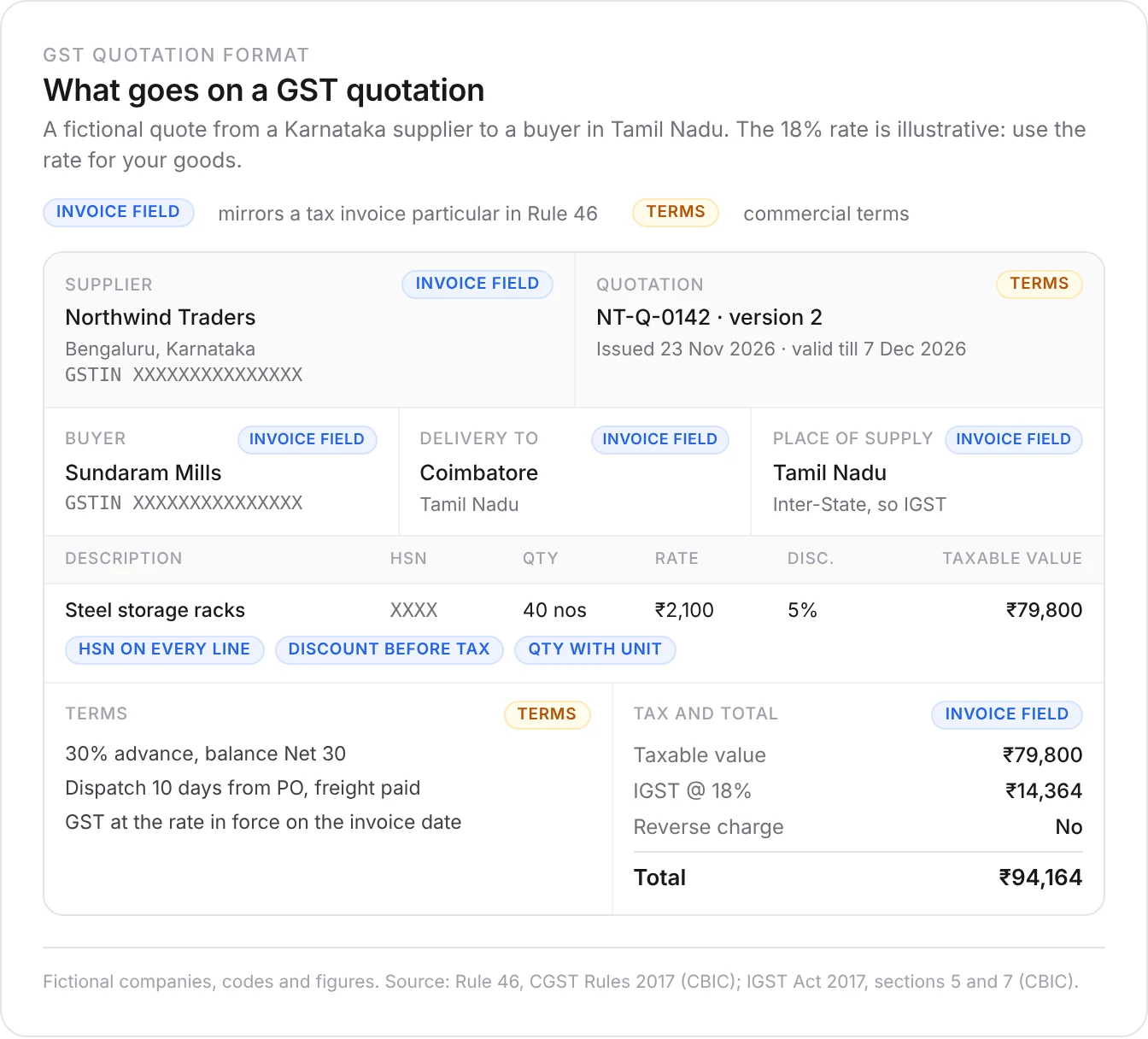
Start from the tax invoice fields in Rule 46 of the CGST Rules, then add the commercial terms a buyer needs to say yes.
Fields that mirror the tax invoice:
- Your name, address and GSTIN.
- Buyer's name, address and GSTIN, if they are registered.
- Delivery address, if it is different from the billing address.
- Description of each item, with quantity and unit for goods.
- HSN code for goods or SAC for services, on every line.
- Taxable value after any discount. Rule 46 asks for the taxable value "taking into account discount", so show the discount before tax, not after.
- GST rate and tax amount, split into central tax and State tax, or integrated tax.
- Place of supply, with the name of the State, for an inter-State supply.
- Whether tax is payable on reverse charge, where that applies to what you sell.
Commercial terms the invoice does not carry:
- A quote number and version, so everyone knows which one was approved.
- A validity date.
- Payment terms, such as advance, Net 30 or milestones.
- Delivery timeline and who pays for freight.
- A line saying GST will be charged at the rate in force on the invoice date.
How do you decide between CGST + SGST and IGST?
Compare the State you supply from with the place of supply. If both are in the same State, it is an intra-State supply (IGST Act, section 8) and attracts central tax (CGST Act, section 9) along with State tax. If they are in different States, it is an inter-State supply (IGST Act, section 7) and attracts integrated tax (IGST Act, section 5).
The tricky part is the place of supply, because it is not always the buyer's billing address. For goods, section 10 of the IGST Act sets the main rules:
- Goods that move: the place of supply is where the movement ends for delivery to the recipient.
- Goods delivered on a third person's direction: the place of supply is that third person's principal place of business.
- Goods installed or assembled at site: the place of supply is where they are installed.
Two cases catch sales teams out. First, a supply to a unit or developer in a Special Economic Zone is treated as inter-State, even when the buyer sits in your own State (sections 7 and 8). Second, services have their own place of supply rules, so check those with your accountant rather than assuming the goods rules apply.
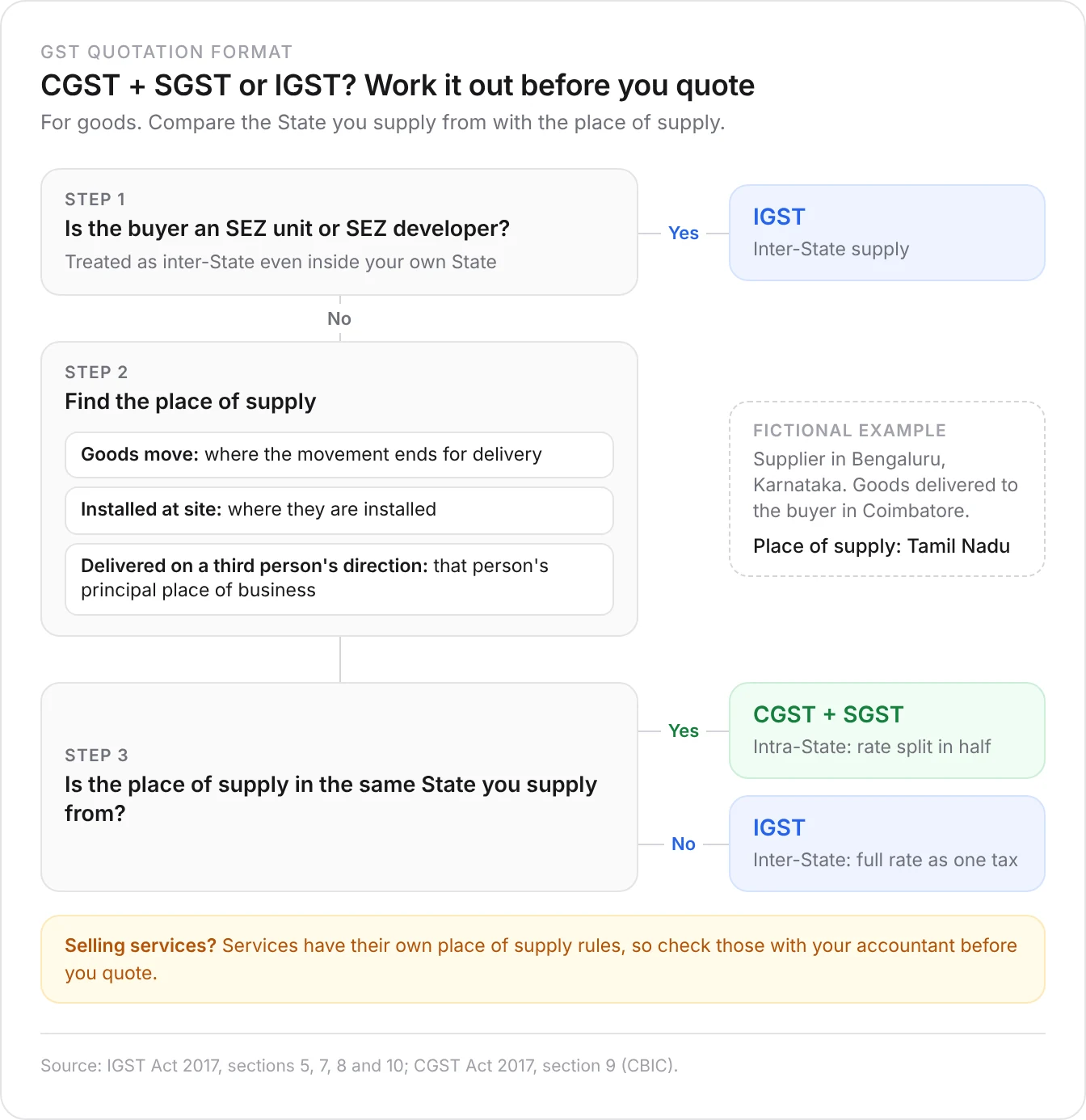
Consider a fictional distributor, Northwind Traders, registered in Karnataka. It sends two quotes for the same ₹79,800 order. The one to a buyer in Bengaluru shows CGST and SGST at half the rate each. The one to Sundaram Mills, with delivery to Coimbatore, shows IGST at the full rate. The total tax is the same. Only the type of tax changes, and getting it wrong means correcting the invoice later.
How many HSN digits should a quotation show?
Use the same number of digits your invoice needs. Under Notification 78/2020-Central Tax, from 1 April 2021 a business with aggregate turnover up to ₹5 crore in the previous financial year shows a 4-digit HSN code, and a business above ₹5 crore shows 6 digits. The same notification lets businesses up to ₹5 crore leave the code off invoices for supplies to unregistered buyers.
For B2B quotes, show the code anyway. It lets the buyer's accounts team check the rate before approving. GSTN's advisory on reporting HSN codes in GSTR-1 follows the same 4-digit and 6-digit split (GST portal advisory).
Which GST rate should go on the quote?
The rate that will apply when you invoice. Usually that is today's rate, but rates do change. The 56th GST Council meeting moved GST to a two-rate structure of 5% and 18%, removed the 12% and 28% rates, and added a 40% rate for certain luxury and sin goods, effective 22 September 2025 (PIB, GST Reforms 2025).
A quote sent in early September that year for delivery in October could have carried the wrong rate. Two habits help:
- Show the rate, not just "GST extra". A buyer cannot budget on a tax line with no number.
- Add a rate clause. Say that GST will be charged at the rate applicable on the date of invoice. The CBIC guide notes that for goods, the time of supply is broadly the date the invoice is issued.
What is the difference between a quotation, a proforma invoice and a tax invoice?
A quotation is your offer. A proforma invoice is a commercial document often sent once the buyer has agreed, so they can raise a purchase order or release an advance; the CBIC guide lists it among the general types of invoice used in trade. A tax invoice is the GST document issued at the time of supply, and it is what the buyer needs to claim input tax credit.
If the buyer pays an advance, GST has a separate document for that: a receipt voucher. The CBIC guide notes that GST on advances is payable for services only, not for goods.
What are the most common GST quotation mistakes?
- The wrong tax type. CGST and SGST on a quote for delivery to another State.
- Discount after tax. A discount applied to the GST-inclusive total, when the invoice will apply it to the taxable value.
- A missing buyer GSTIN. The invoice then goes out without it, and the buyer asks for a revision.
- An out-of-date rate. A template saved before a rate change and reused months later.
- Lost versions. Three revisions sent over email and chat, and nobody sure which one the buyer accepted.
Lost versions are a sales process problem more than a tax one. A quote is usually where a deal moves into the "Quote sent" stage, which we cover in sales pipeline stages. If the versions live in a shared drive, the pipeline cannot tell which price is live.
How does HeiGin handle GST quotes?
HeiGin is an agentic CRM for Indian B2B sales teams, and quotes sit on the same record as the deal:
- GST quotes on the deal. Create, version and approve quotes on the deal record, as shown on the product page.
- A link and a PDF. Each quote has a public share link for the customer, and a PDF.
- Versions you can trace. The quote history sits on the customer timeline with the emails, calls and tasks around it.
- Changes go to review. Quotation changes default to a review step, so an agent can prepare a revision but a person approves it. We explain why in how we think about agent trust.
Once a quote is out, the next risk is silence. Why follow-ups slip covers how to keep the conversation moving after the PDF lands.
Frequently asked questions
Is GST mandatory on a quotation?
GST law does not prescribe a quotation format, so there is no rule that a quote must show GST. In practice, a B2B quote should show the GST rate, the tax amount and whether it is CGST plus SGST or IGST, because the buyer will compare it with the tax invoice. Leaving tax out leads to disputes when the invoice arrives.
Can I write "GST extra" on a quotation?
You can, but it leaves the buyer to work out the tax themselves. Show the rate and the tax amount on each line instead, and add a clause that GST will be charged at the rate in force on the invoice date. That keeps the quote clear if rates change before delivery.
Should a quotation show HSN codes?
It is good practice for B2B quotes. Invoices need a 4-digit HSN code if your aggregate turnover was up to ₹5 crore in the previous financial year, and 6 digits above that, under Notification 78/2020. Putting the same code on the quote lets the buyer check the rate before approving.
Which GST applies when the buyer is in another State?
Compare your location with the place of supply. For goods that move, the place of supply is generally where delivery ends. If that is in another State, the supply is inter-State and attracts IGST. If it is in your State, it attracts CGST and SGST, unless the buyer is an SEZ unit or developer, which is treated as inter-State.
What is the difference between a quotation and a proforma invoice?
A quotation is an offer that the buyer can accept, reject or negotiate. A proforma invoice is usually sent after agreement, so the buyer can raise a purchase order or pay an advance. Neither replaces the GST tax invoice issued at the time of supply.
Does a quotation need a serial number?
GST rules require a consecutive serial number on tax invoices, not on quotations. Numbering quotes and their versions is still worth doing, because it shows which version the buyer accepted and makes the invoice easy to match against it.
Sources
- Rule 46, Tax invoice, CGST Rules 2017 (CBIC)
- Tax Invoice and other such instruments in GST (CBIC, via GST Council)
- Section 5, IGST Act 2017: Levy and collection (CBIC)
- Section 7, IGST Act 2017: Inter-State supply (CBIC)
- Section 8, IGST Act 2017: Intra-State supply (CBIC)
- Section 10, IGST Act 2017: Place of supply of goods (CBIC)
- Section 9, CGST Act 2017: Levy and collection (CBIC)
- Notification No. 78/2020-Central Tax: HSN digits on tax invoices (GST Council)
- Implementation of mandatory mentioning of HSN codes in GSTR-1 (GST portal)
- GST Reforms 2025: Relief for Common Man, Boost for Businesses (PIB)