Sales pipeline stages: how to set them up so deals don't stall
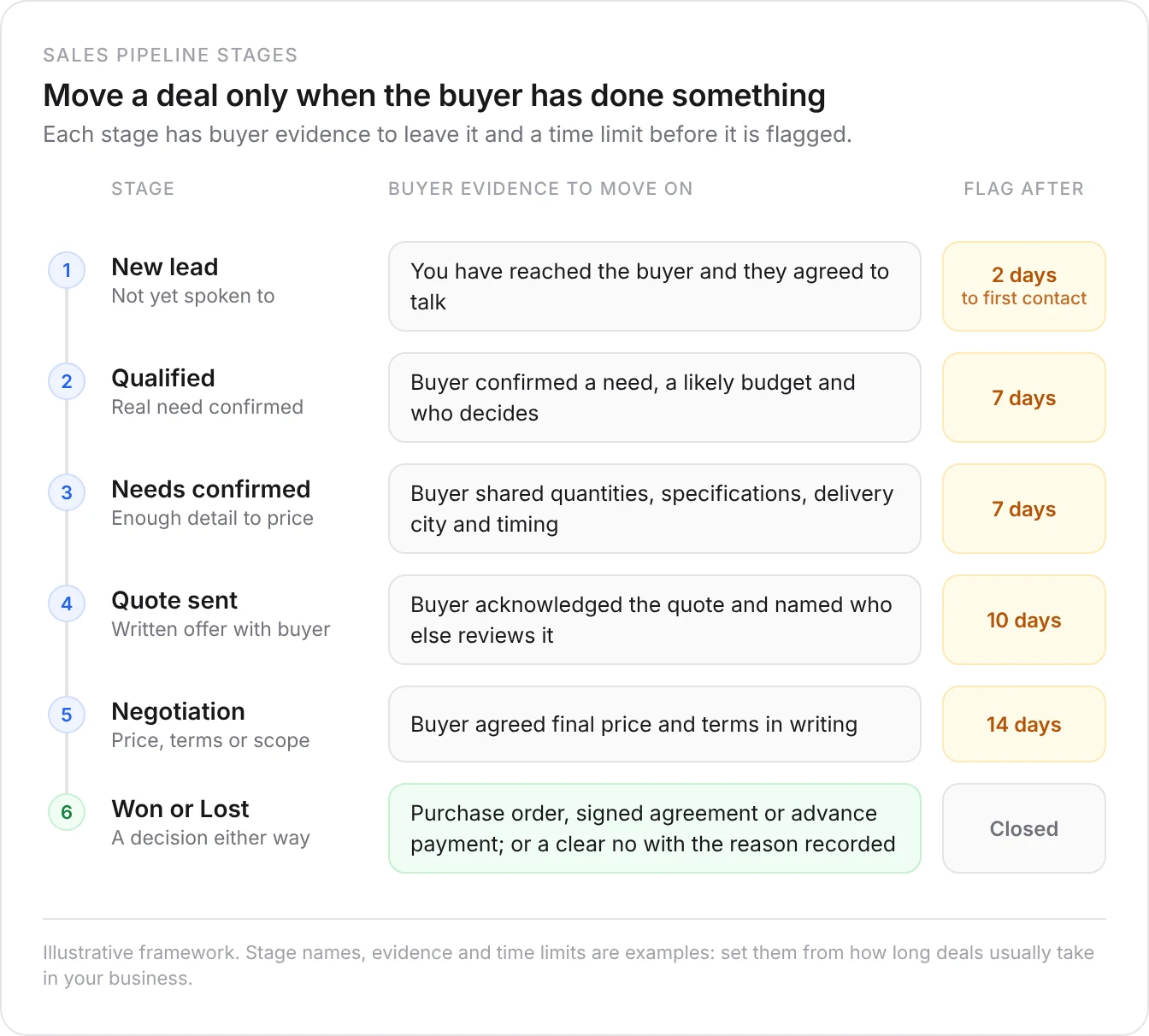
Sales pipeline stages are the steps a deal moves through from first contact to won or lost. Most B2B teams need five or six, each with a clear exit rule based on what the buyer has done, plus a time limit that flags a stalled deal before it quietly dies.

Sales pipeline stages: how to set them up so deals don't stall
Sales pipeline stages are the steps a deal moves through, from first contact to won or lost. Most B2B teams need five or six of them. The names matter less than the rule for leaving each one: a deal should move forward only when the buyer has done something you can point to, such as confirming a need or receiving a quote. Give every stage a time limit too, so a deal that sits past it is flagged as stalled and gets a decision instead of a hopeful "following up".
What are sales pipeline stages?
A sales pipeline is the list of open deals your team is working, and its stages are the checkpoints each deal passes on the way to a decision. A stage tells everyone where a deal stands without opening the full history: whether the buyer has a confirmed need, whether a quote has gone out, and whether it is time to negotiate.
Stages also feed the forecast. Many CRMs attach a likelihood of closing to each stage and use it to weight the deal value. HubSpot's default deal pipeline, for example, has seven stages, running from "Appointment scheduled" at 20% to "Contract sent" at 90%, plus Closed won and Closed lost (HubSpot Knowledge Base). Those percentages are only as good as the discipline behind each stage. If reps move deals forward on optimism, the forecast inherits that optimism.
How many stages should a B2B sales pipeline have?
Five or six open stages, plus Won and Lost, suits most small and mid-sized B2B teams. Fewer, and very different deals share one stage. More, and reps stop updating them because the difference between stages is unclear.
A simple set for an Indian B2B team might look like this:
- New lead. An enquiry or contact that nobody has spoken to yet.
- Qualified. You have spoken to the buyer and confirmed they have a real need, a likely budget and someone who can decide.
- Needs confirmed. The buyer has told you what they want in enough detail to price it: quantities, specifications, delivery location and timing.
- Quote sent. A written quote or proposal is with the buyer.
- Negotiation. The buyer has responded to the quote and you are discussing price, terms or scope.
- Won or Lost. A purchase order, signed agreement or advance payment, or a clear no with a reason recorded.
Rename these to fit how you sell. A manufacturer that sends samples may need a "Sample sent" stage. What should not change is that each stage has an entry test and a time limit.
Why should pipeline stages follow what the buyer does?
Because the buyer, not the rep, decides when a deal is closer to a yes. Gartner research found that B2B customers spend around two-thirds of a buying journey gathering, processing and reconciling information, and that much of it happens without a sales rep involved (Gartner). A stage called "Demo given" records something the seller did. It says nothing about whether the buyer learnt what they needed.
Exit criteria written around buyer actions are harder to fake:
- Weak exit rule: "Rep sent the quote."
- Strong exit rule: "Buyer confirmed they received the quote and named who else reviews it."
- Weak exit rule: "Had a good call."
- Strong exit rule: "Buyer shared quantities, delivery city and a target date."
A good test: could a colleague look at the deal record and agree it belongs in that stage? If the evidence is only in the rep's head, the stage is a guess.
What is a stalled deal?
A stalled deal is an open deal that has gone longer than your set limit without progress or a reply from the buyer. It has not been lost, but nothing is moving it either.
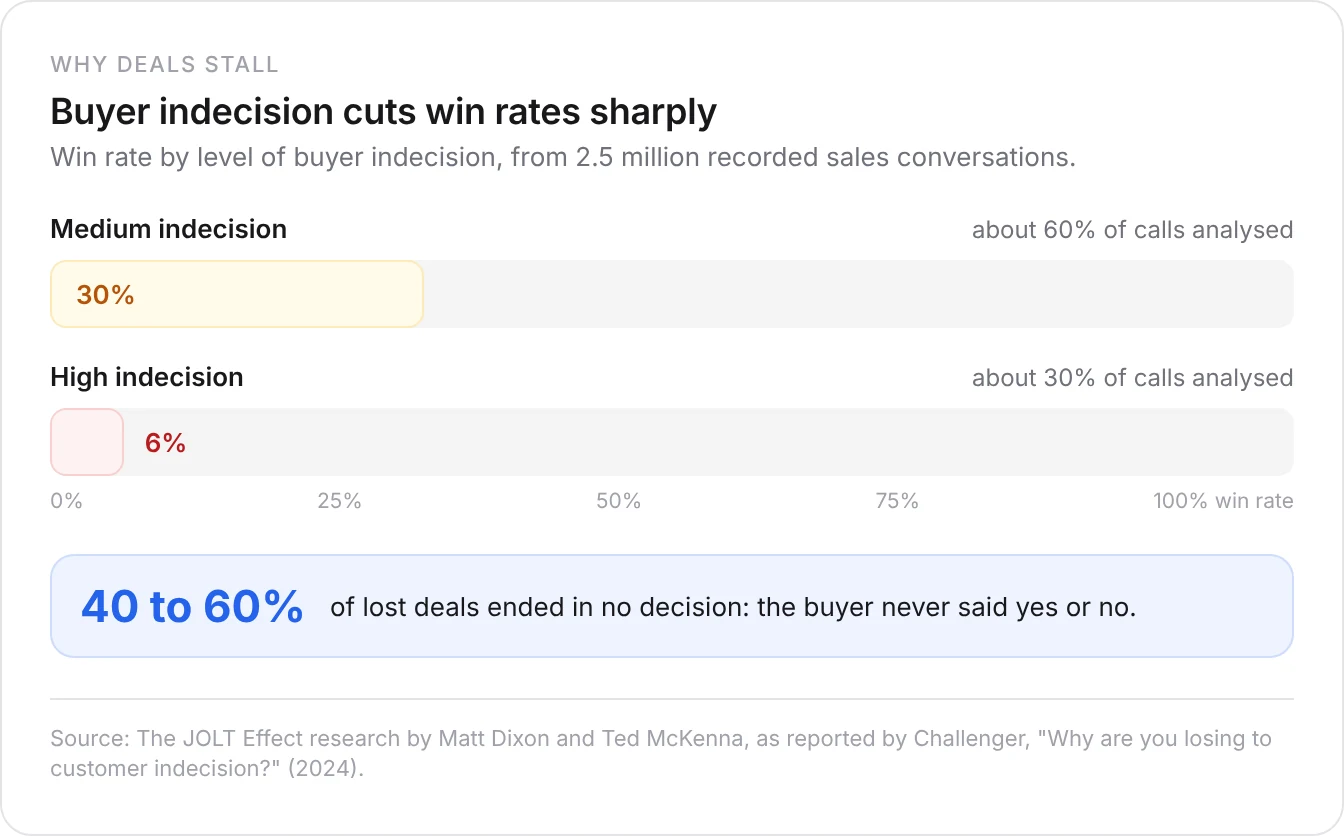
Stalls usually come from indecision rather than a firm no. In research behind the book The JOLT Effect, Matt Dixon and Ted McKenna analysed 2.5 million recorded sales conversations. They found that 40 to 60% of lost deals ended in no decision (Challenger). The same research reports win rates of 30% where buyers showed medium indecision and just 6% where indecision was high.
Deals are also taking longer. In Salesforce's 2026 State of Sales research, 57% of sales professionals said the sales cycle is getting longer (Salesforce). Longer cycles leave more room for a deal to go quiet unnoticed.
How do you keep a sales pipeline clean?
Keep a pipeline clean by giving every open deal three things: one owner, a dated next step and a stage it has earned. Then review the exceptions every week, not every deal. This routine is often called pipeline hygiene, and it is becoming a priority: Salesforce reports that 74% of sales teams using AI are prioritising data hygiene to support it (Salesforce).
A routine that works for small teams:
- One owner per deal. Shared deals become nobody's deal.
- A next step with a date on every open deal. "Follow up" is not a next step. "Call Meera on Thursday to confirm the delivery date" is.
- A time limit for each stage. Pick a number of days that fits your usual cycle and flag deals that pass it.
- A reason for every lost deal. Price, timing, competitor, no budget or no decision. Over a quarter, these reasons tell you which stage leaks.
- A weekly stall review. Go through only the flagged deals and decide what happens to each one.
- No backdating. If a deal moves stage, the evidence should already be on the record.
Missed next steps are the most common cause of stalls, which we look at in why follow-ups slip. If your team still tracks deals in a shared sheet, stage discipline is hard to hold, and CRM vs spreadsheet covers when to move.
What should you do with a stalled deal?
Every stalled deal needs one of three decisions: revive it with a specific next step, move it back a stage, or close it as lost with a reason. Leaving it open "just in case" inflates the forecast and hides the deals that do need attention.
- Revive it. Send something that makes the buyer's decision easier, not another "just checking in". The JOLT research found that high performers responded to indecision by offering a clear recommendation, limiting further exploration and taking risk off the table (Challenger).
- Move it back. If the buyer's need, budget or decision-maker has changed, the deal no longer meets the exit rule for its stage. Moving it back is honest and makes the forecast more accurate.
- Close it as lost. If two genuine attempts get no reply, close it and record "no decision" as the reason. You can reopen it if the buyer comes back.
Consider a fictional company, Northwind Traders, with a restock deal that has sat in "Quote sent" for 16 days against a limit of 10. The rep has emailed twice asking for an update. In the weekly review, the call notes show the buyer was worried about delivery timing. The next message offers a split delivery, with the first lot in two weeks, and asks for a decision by Friday. That is a revive with a reason, not another nudge.
When buyers do reply, how they reply tells you a lot about where the deal really stands. We cover reading those signals in AI lead scoring.
How does HeiGin approach pipeline stages and stalled deals?
HeiGin is an agentic CRM for Indian B2B sales teams. It is designed so that pipeline hygiene happens as the work happens, rather than in a Friday clean-up:
- Stall flags on the deal. Deal brief flags inactivity as it happens and shows the reason on the pipeline, so a stall is visible while there is still time to act. You can see this on the product page.
- A suggested next step. Deal brief suggests what the deal needs next, referencing the last conversation, and tells the owner.
- Stage changes you confirm. Copilot proposes stage changes, new tasks and bulk clean-ups, and nothing is committed until you confirm it.
- One timeline per customer. Every email, call, quote and task sits on the same record, so the evidence for a stage is in one place.
- Plain-English questions. Managers can ask Copilot about the pipeline in plain English instead of building a report.
The use cases page shows how stalled deals move from "activity stops" to "owner acts", and the AI agents page lists what each agent reads and does.
Frequently asked questions
What are the stages of a sales pipeline?
A typical B2B sales pipeline has New lead, Qualified, Needs confirmed, Quote sent, Negotiation, and then Won or Lost. Teams rename or add stages to fit how they sell, such as a stage for samples. Each stage should have a clear rule for when a deal can move on.
How many stages should a sales pipeline have?
Most small and mid-sized B2B teams do well with five or six open stages plus Won and Lost. Fewer stages lump very different deals together, while too many make reps stop updating them. If two stages are hard to tell apart, merge them.
What are exit criteria in a sales pipeline?
Exit criteria are the conditions a deal must meet before it moves to the next stage. The strongest ones are based on what the buyer has done, such as confirming quantities or acknowledging a quote, rather than on what the rep has done. They make stages consistent across the team and the forecast more reliable.
How long before a deal counts as stalled?
There is no single number. Set a limit for each stage based on how long deals usually take there in your business, for example 7 to 14 days, and flag any deal that goes past it without progress or a reply. Review flagged deals weekly and decide whether to revive, move back or close each one.
What is pipeline hygiene?
Pipeline hygiene is the habit of keeping deal records accurate and current: one owner per deal, a dated next step, an earned stage and a reason for every lost deal. A clean pipeline makes forecasts more honest and shows the team which deals need attention now.
Should you close stalled deals as lost?
If two genuine attempts to restart a deal get no response, closing it as lost with "no decision" as the reason is usually better than leaving it open. It keeps the forecast honest and the deal can be reopened if the buyer returns. Recording the reason also shows which stage loses the most deals.
Sources
- Set up and manage object pipelines (HubSpot Knowledge Base)
- Gartner says B2B buyers want more simplicity in accessing the right information, with or without a sales rep (Gartner, 2018)
- Why are you losing to customer indecision? The JOLT Effect (Challenger)
- 40 sales statistics to watch for in 2026, State of Sales (Salesforce)