AI lead scoring: how to read buying intent in what leads say
AI lead scoring ranks leads by how likely they are to buy. The strongest signal is often the buyer's own words, so scoring replies and calls as Hot, Warm or Cold tells your team who to answer first.

Please send the quote for 500 metres by Friday. Rate thoda kam ho sakta hai?
AI lead scoring: how to read buying intent in what leads say
AI lead scoring uses machine learning or language models to rank leads by how likely they are to buy, so sales reps know who to contact first. Classic scoring adds points for activity such as email opens and page visits. The clearer signal is usually what the buyer actually says: a reply that names a quantity, a deadline or a price question shows more intent than any number of clicks. Reading those words and sorting replies into Hot, Warm and Cold is the most practical form of lead scoring for a small B2B sales team.
What is lead scoring?
Lead scoring is a way of giving each lead a value that reflects how likely it is to become a customer. HubSpot describes it as "assigning a score or value to each lead" and splits the inputs into two kinds (HubSpot):
- Fit, or explicit data. What the lead tells you about themselves: industry, location, job title, company size.
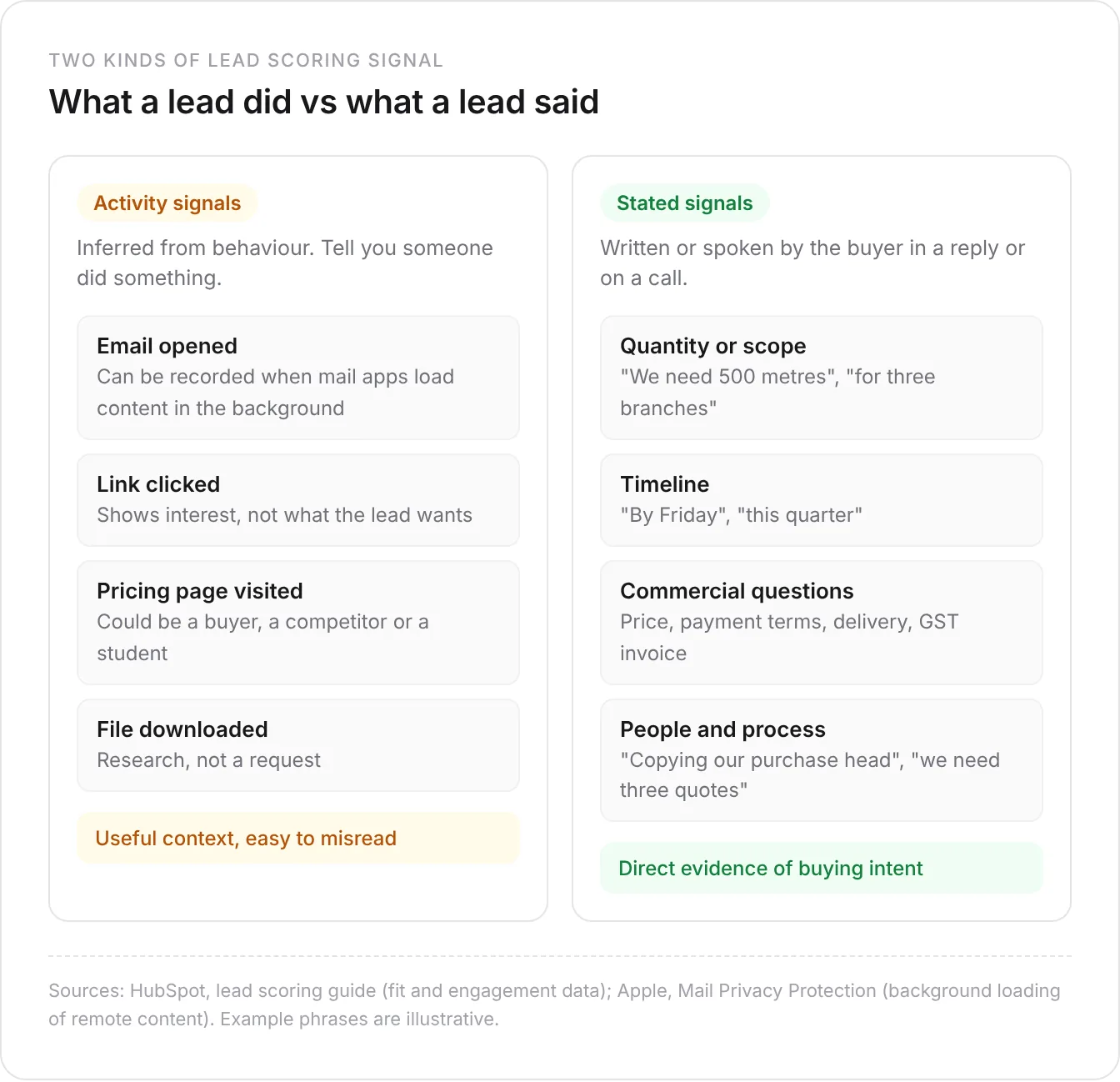
- Engagement, or implicit data. What you infer from behaviour: emails opened, links clicked, pages visited, files downloaded.
Most models also subtract points. HubSpot's guide lists negative scoring for leads who stop opening emails or who fill in forms with obviously fake details (HubSpot).
The output is the same either way: a ranked list, or a label such as Hot, Warm or Cold, that tells a rep where to spend the next hour.
How is AI lead scoring different from rule-based scoring?
Rule-based scoring uses points a person sets by hand, such as ten points for a pricing page visit and five for an email open. AI lead scoring learns the pattern from data, or reads unstructured text like emails and call transcripts, and updates the score as new information arrives.
There are two broad approaches, and they answer different questions:
- Predictive scoring looks at past leads that converted and finds similar ones. HubSpot notes that its predictive model estimates the likelihood of buying over one, three or six months (HubSpot). It needs a reasonable history of won and lost deals to learn from.
- Intent scoring from language reads what a buyer wrote or said in a specific message and judges how ready they are to act. It works from the first reply, with no training history, because the evidence is in the message itself.
For a small sales team with a few hundred deals a year, the second approach is often the useful one. You may not have enough history to train a predictive model, but every day you get replies and calls that need sorting.
Why are email opens a weak buying signal?
Email opens are weak because they no longer reliably mean a person read the email. Apple's Mail Privacy Protection downloads remote content in the background "regardless of whether you engage with the email" (Apple). Remote content is what open tracking depends on, so an "open" can be recorded without anyone looking at the message.
Clicks and page visits are better, but they still leave you guessing. A pricing page visit could be a buyer, a competitor or a student. Activity tells you someone did something. It does not tell you what they want.
Buyers are also giving sellers fewer chances to observe them. In a Gartner survey of 646 B2B buyers, 67% said they prefer a buying experience without a sales rep, and 45% said they used AI during a recent purchase (Gartner, March 2026). When buyers do most of their research alone, the moment they write back is rare and valuable.
What buying signals show up in a reply?
The strongest buying signals in a reply are specifics: the buyer is planning a purchase, not browsing. Look for these:
- Quantity or scope. "We need 500 metres", "for three branches", "about 20 users".
- A timeline. "By Friday", "before the season starts", "this quarter".
- Commercial questions. Price, payment terms, delivery, GST invoice, minimum order.
- People and process. "Copying our purchase head", "my director wants a call", "we need three quotes".
- Comparison. "Your rate is higher than our current supplier." Pushback on price still shows the buyer is evaluating.
Weak or negative signals matter too. "Send me your brochure" with no context, "maybe next year" or "we already have a vendor" all tell a rep to slow down. Gartner found that 69% of B2B buyers prefer to check AI-generated insights with sales reps (Gartner, May 2026), so a buyer asking you to confirm what they already read is often further along than they look.
In India, many of these signals arrive in mixed language. "Rate thoda kam ho sakta hai?" (can the rate come down a little?) is a price negotiation, and a scoring model has to understand Hinglish to catch it.
How should a sales team act on Hot, Warm and Cold?
Each label should map to a clear next step, so the score changes what reps do and is more than decoration. A simple version:
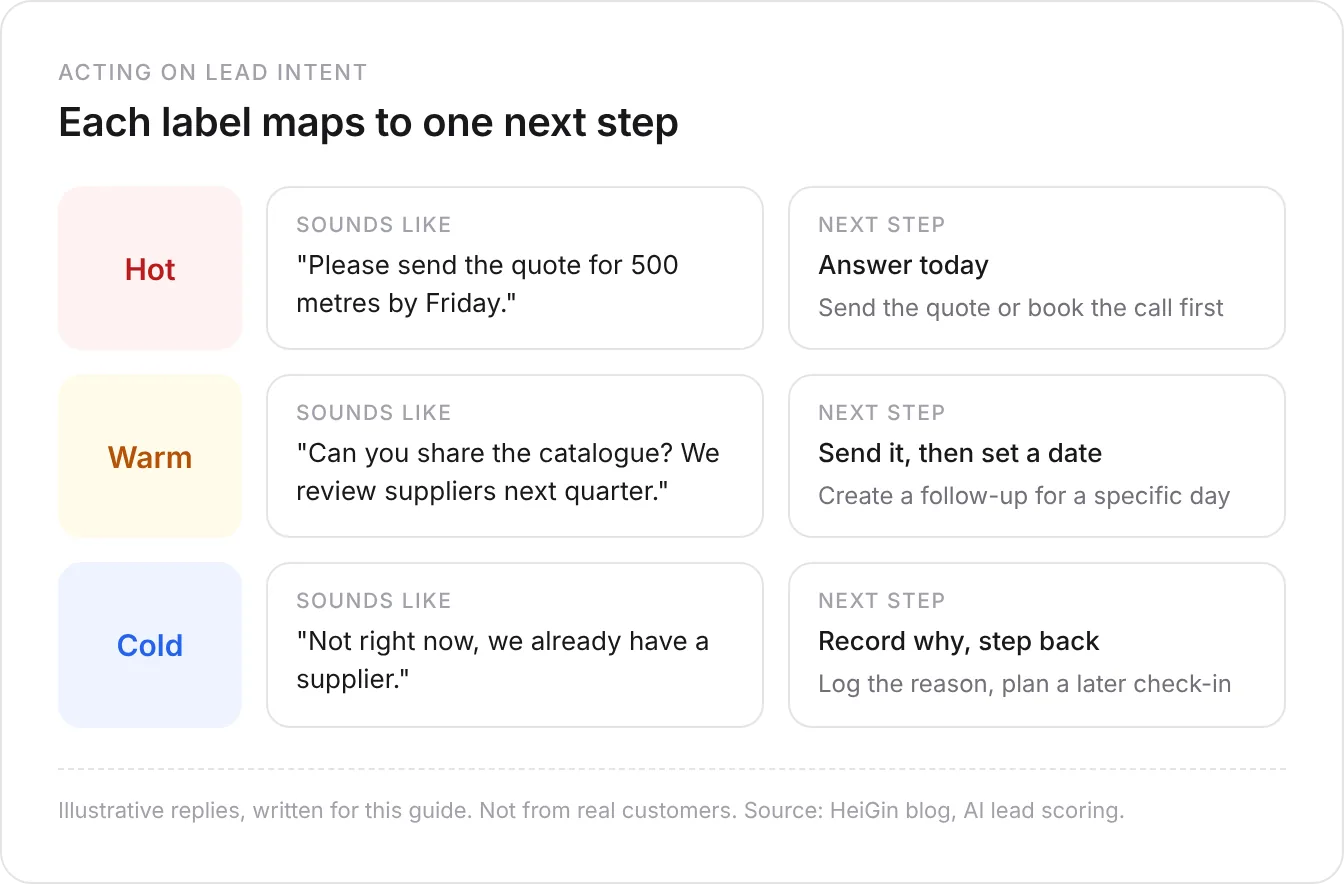
- Hot: answer today. The buyer has named a need and a time. Send the quote, book the call or answer the commercial question before anything else. Speed matters here: researchers writing in Harvard Business Review found that most companies are "not responding nearly fast enough" to online leads (HBR).
- Warm: give them what they asked for, then set a date. Share the catalogue or case study, and create a follow-up with a specific day attached. Warm leads are where most follow-ups slip, because nothing feels urgent.
- Cold: record why, then step back. Note the reason, such as an existing supplier, no budget or wrong contact, and set a long-dated check-in if it makes sense. A Cold label is information. It stops reps from chasing the wrong lead.
Consider a fictional distributor, Northwind Traders, that gets thirty replies on a Monday morning. Without scoring, a rep works through them top to bottom. With scoring, the four Hot replies asking for quotes go first, the twelve Warm ones get answered with information and a dated task, and the Cold ones are logged in a few minutes. The rep spends the morning on the leads most likely to buy.
This matters because selling time is scarce. In Salesforce's 2026 State of Sales survey of more than 4,000 sales professionals, reps said they spend 60% of their time on non-selling tasks (Salesforce). Sorting an inbox by hand is one of those tasks.
How do you keep AI lead scoring honest?
Treat the score as a recommendation a rep can check, not a verdict. Three habits help:
- Show the evidence. A score is easier to trust when the rep can see the message or call it came from.
- Let people overrule it. If a rep knows the buyer, their judgement should win, and the record should show what changed.
- Watch the inputs. Salesforce reports that 84% of data and analytics leaders agree AI's outputs are only as good as its data inputs (Salesforce). Duplicate contacts and replies logged against the wrong lead will skew any score.
How does HeiGin approach lead intent?
HeiGin is an agentic CRM for Indian B2B sales teams, and it scores intent from what buyers say:
- Intent scoring rates email replies as Hot, Warm or Cold. The score shows in the Inbox, on the lead page and in the Leads column, so reps can see who to answer first.
- Call agent turns a recorded call in English, Hindi or Hinglish into a transcript, summary, intent score and suggested follow-up tasks shortly after the call ends.
- Deal brief gives each deal a short brief on its page, and buying signals surface on the pipeline with the reason attached, as described on the product page.
- Sales Agent drafts replies using only the campaign's own offer, FAQs and PDFs, and outbound messages go to review before they are sent.
The score helps people decide. It does not act on its own. That follows the same principle we describe in how we think about agent trust. You can see what each agent reads and does on the AI agents page.
Frequently asked questions
What is AI lead scoring?
AI lead scoring uses machine learning or language models to rank leads by how likely they are to buy. It can learn from past deals that converted, or read the words in a buyer's reply or call to judge intent. The result is usually a score or a label such as Hot, Warm or Cold.
What is the difference between lead scoring and intent scoring?
Lead scoring is the broad practice of ranking leads, often by combining fit data such as industry with activity data such as clicks. Intent scoring focuses on how ready a buyer is to act, based on what they have actually said. A reply asking for a quote by Friday scores high on intent even if the lead has never opened a newsletter.
Are email opens still useful for lead scoring?
Only a little. Apple's Mail Privacy Protection loads email content in the background whether or not the person engages, so an open can be recorded without anyone reading the message. Replies, calls and specific questions are far more reliable signals.
What makes a lead Hot, Warm or Cold?
A Hot lead has named a need and a time, for example a quantity and a deadline, or a direct price question. A Warm lead is interested but not yet committed, such as asking for a catalogue or saying they review suppliers next quarter. A Cold lead has said no for now, has an existing vendor or has gone quiet.
Does AI lead scoring work for small businesses?
Yes, especially intent scoring from replies. Predictive models need a long history of won and lost deals, which many small teams do not have. Reading the intent in each reply works from the first message.
Should AI decide which leads to drop?
No. A score should help a rep decide where to start, and the rep should be able to see why a lead was scored the way it was. Dropping or closing a lead is a commercial decision that should stay with a person.
Sources
- Lead scoring explained (HubSpot)
- Mail Privacy Protection and privacy (Apple)
- Gartner sales survey finds 67% of B2B buyers prefer a rep-free experience (Gartner, March 2026)
- Gartner survey finds 69% of B2B buyers turn to sales reps to validate AI-generated insights (Gartner, May 2026)
- Sales statistics from the State of Sales report (Salesforce)
- The Short Life of Online Sales Leads (Harvard Business Review, 2011)