DPDP Act for sales teams: what changes for your CRM
DPDP compliance for CRM data means knowing why you hold each lead, having a lawful basis to contact them, limiting access and erasing what you no longer need. Here is what India's DPDP Act and Rules ask of sales teams, and by when.

- Nov 2025Rules published
- Nov 2026Consent Managers
- May 2027Core duties
From May 2027
DPDP Act for sales teams: what changes for your CRM
India's Digital Personal Data Protection Act, 2023 treats the names, phone numbers and email addresses in your CRM as personal data. It makes your business responsible for how that data is collected, used, shared and deleted. DPDP compliance for CRM data comes down to four habits: record why you hold each contact, have a lawful basis to use it, control who can see and export records, and erase what you no longer need. Most of these duties apply from May 2027, so sales teams have a few months left to clean up.
This post is a practical reading for sales leaders, not legal advice. Check the specifics for your business with a qualified lawyer.
What is the DPDP Act, and does it apply to sales data?
Yes, it applies to most sales data. The Act covers digital personal data processed in India, including data first collected on paper and digitised later. It defines personal data as any data about an individual who is identifiable by or in relation to that data (DPDP Act, sections 2(t) and 3). A lead's name and mobile number fit that definition, whether the lead runs a small shop or heads procurement at a large company.
In the Act's terms, your business is the Data Fiduciary: it decides why and how the data is processed. Your CRM vendor, dialler or email tool usually acts as a Data Processor on your behalf. The Act keeps the fiduciary responsible for processing done on its behalf, and allows processors to be engaged only under a valid contract (sections 8(1) and 8(2)).
Is B2B contact data exempt?
We found no B2B exemption in the Act. What it does leave out is personal data used by an individual for personal or domestic purposes, and personal data made publicly available by the person themselves or by someone legally required to publish it (section 3(c)). A visiting card scanned into your CRM sits in neither bucket by default. Whether a public profile counts as "made publicly available" for your use is a question for your lawyer.
When do the DPDP Rules apply to sales teams?
MeitY published the DPDP Rules and the enforcement timeline for the Act in mid-November 2025, with the notifications dated 13 November 2025 (enforcement timeline; PIB backgrounder). They take effect in three phases:
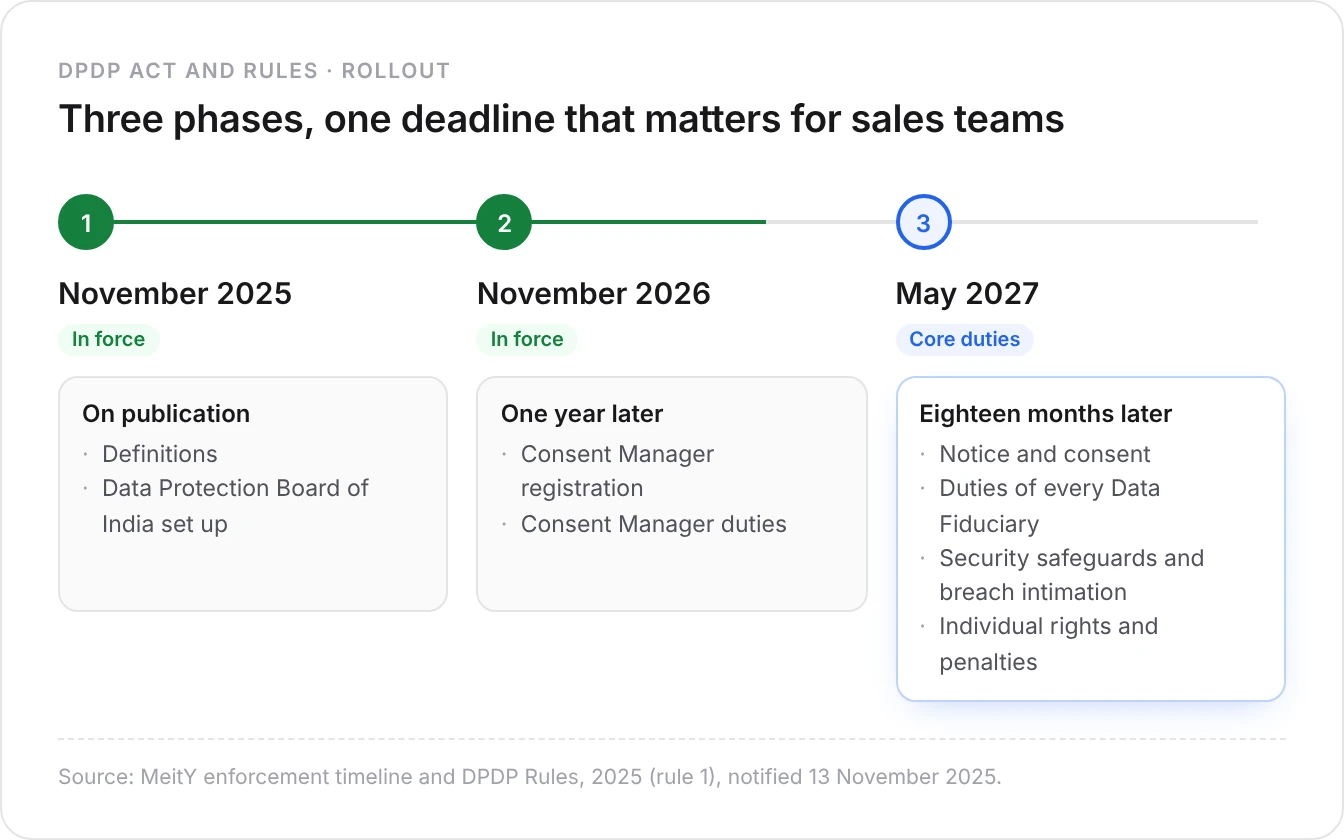
- November 2025, on publication: definitions and the Data Protection Board of India.
- November 2026, one year later: registration and duties of Consent Managers.
- May 2027, eighteen months later: notice and consent, legitimate uses, duties of Data Fiduciaries, individual rights, security safeguards, breach intimation and penalties.
The phases come from the enforcement timeline and rule 1 of the DPDP Rules, 2025.
In early 2026, MeitY sought feedback on shortening the window for some larger businesses, as reported by S.S. Rana & Co. Treat May 2027 as the latest date, not a comfortable one, and watch MeitY's notifications.
Do I need consent to contact a sales lead?
Usually yes, unless another lawful basis applies. Consent under the Act must be free, specific, informed, unconditional and unambiguous, given through a clear affirmative action. People can withdraw it as easily as they gave it (section 6). The Rules add that the notice asking for consent must make sense on its own, list the data in an itemised way and state the specific purpose (rule 3).
One route matters for inbound sales. Section 7(a) allows processing for the specified purpose for which a person voluntarily shared their data, as long as they have not said they do not consent (section 7(a)). A buyer who fills in your enquiry form asking for a quotation has shared their number for that purpose. Adding the same number to an unrelated promotional campaign months later is a different purpose.
Purchased lists carry the most risk. Writing for Chambers and Partners, counsel Abhishek Mitra argues that bought lists and data-broker sources "will have no place going forward" (Chambers and Partners). Whatever view your own lawyer takes, if you cannot show how and why a contact entered your CRM, you will struggle to show a lawful basis for using it.
What does the DPDP Act mean for the data inside your CRM?
The duties translate into specific CRM hygiene. Here is how the main ones line up with everyday sales operations.
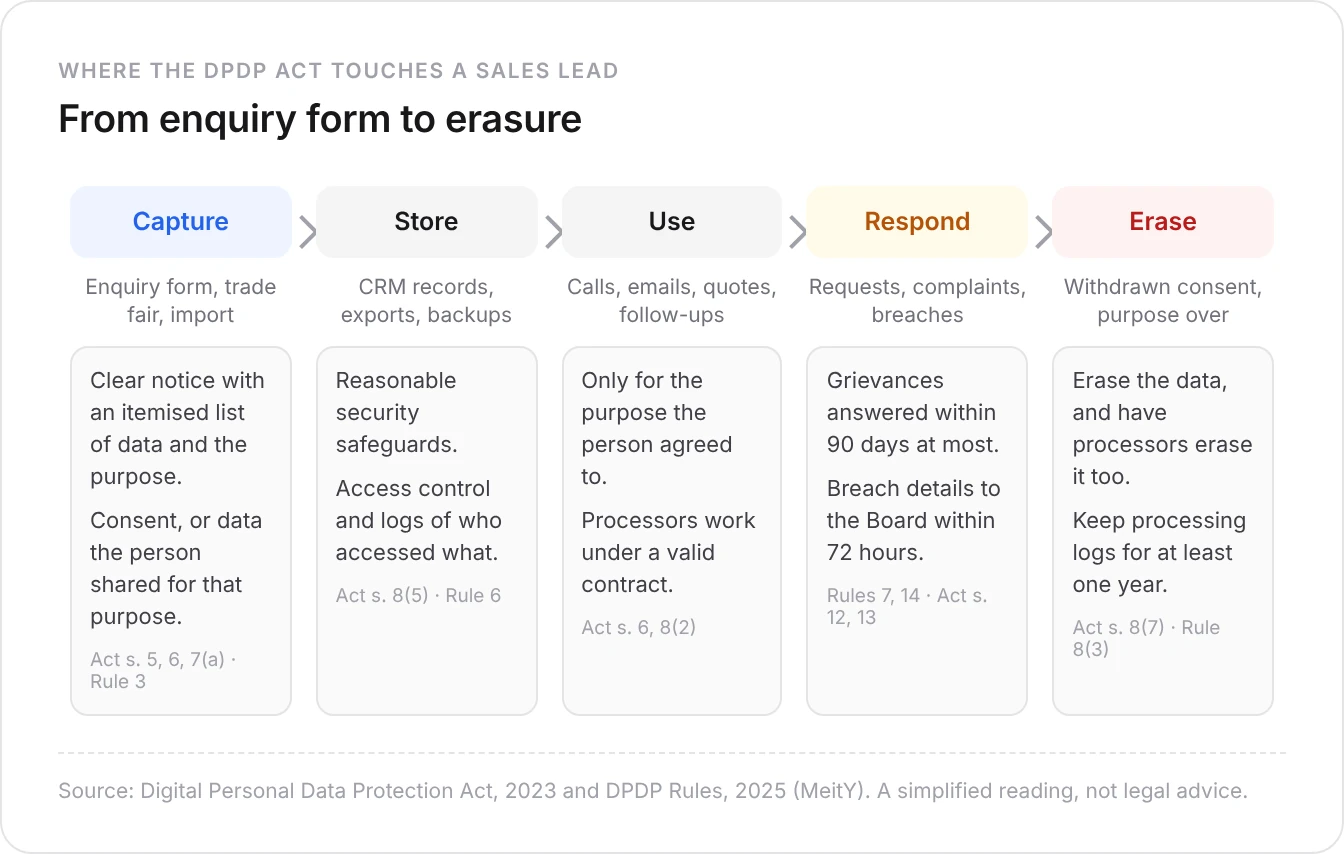
In CRM terms, the main duties look like this:
- Erase when consent is withdrawn or the purpose ends (Act, section 8(7)). Think of leads marked "not interested" years ago, old trade fair uploads and duplicate imports.
- Take reasonable security safeguards, including access control and logs (Act, section 8(5); rule 6). This covers who can view, edit and export contacts, and whether exports leave a trace.
- Keep processing logs for at least one year (rule 8(3)). Activity history and access logs should not be wiped too early either.
- Tell the Board about a breach, with full details within 72 hours (rule 7). A lost laptop holding a CSV export of your leads counts.
- Publish a contact for data questions (rule 9). Someone has to answer "why do you have my number?"
- Respond to grievances within at most 90 days (rule 14). Opt-out and deletion requests from leads fall here.
- Correct and erase on request (Act, section 12). Wrong numbers, changed roles and "please delete my details" all apply.
The penalties are large. The Act's schedule allows penalties of up to ₹250 crore for failing to take reasonable security safeguards, up to ₹200 crore for failing to notify a breach, and up to ₹50 crore for other breaches of the Act or Rules (DPDP Act, Schedule; PIB backgrounder).
How should a sales team prepare its CRM for DPDP?
Start with what you can do this quarter, in this order.
- Map every lead source. List where contacts come from: website forms, marketplaces, trade fairs, imports, referrals and bought lists. Record the source on each record.
- Record the purpose. For each source, note what the person was told and what they asked for. A quotation request and a newsletter sign-up are different purposes.
- Stop spreadsheet sprawl. CSV exports on personal laptops are hard to secure and almost impossible to erase. Keep records in one system with role-based access.
- Limit exports by role. Restrict bulk export to the roles that need it.
- Set a retention review. Decide how long cold leads stay before you erase them, and run that review on a schedule.
- Name a contact and a process. Decide who answers data requests, and how a deletion request reaches every system, including your processors.
- Check vendor contracts. Your CRM, dialler and email tools are processors. Make sure the contracts cover security safeguards, as rule 6 expects.
Consider a fictional company, Northwind Traders, with years of contacts collected from trade fairs, a website form and two purchased lists. Following the steps above, it would tag each record with its source, pause outreach to the purchased-list contacts until it can establish a lawful basis, and review leads that have shown no activity for a long time. The database gets smaller, easier to defend and easier to follow up on.
How does HeiGin approach sales data under the DPDP Act?
HeiGin is an agentic CRM for Indian B2B sales teams, so the data its agents read is exactly the kind of data this law covers. Three controls are built into the product:
- Role-based access. Six roles, from Admin to Read-only, scope what each person, and each agent acting for them, can see and change.
- Human approval by default. Outbound messages and quotation changes go to a review step before anything leaves the system.
- Admin-only audit log. Agent proposals and actions are recorded with who approved them and when.
These are the same kinds of controls rule 6 describes: limits on who can access personal data, and logs that show what happened. You can read more about why agents work inside permissions in how we think about agent trust, or see what HeiGin's agents do.
Frequently asked questions
Does the DPDP Act apply to B2B sales leads?
Yes, in most cases. The Act covers digital personal data about any identifiable individual, and we found no general exemption for business contacts. The work email and mobile number of a named buyer are personal data.
When does DPDP compliance become mandatory for a CRM?
The core duties, including notice, consent, security safeguards, breach intimation and individual rights, apply eighteen months after the Rules were published in November 2025, which means May 2027. The Consent Manager provisions took effect a year after publication, in November 2026.
Can I still use a purchased lead list under the DPDP Act?
It is risky. You need a lawful basis for each contact, usually consent given to your business for a specific purpose, and a bought list rarely comes with proof of that. Take legal advice before using one.
How long can a CRM keep lead data under DPDP?
The Act says personal data should be erased when consent is withdrawn or when the purpose is no longer being served, whichever comes first. Separately, the Rules require processing logs and associated data to be kept for at least one year. Set a written retention period for cold leads and review it regularly.
Who is responsible if my CRM vendor has a data breach?
Your business, as the Data Fiduciary, stays responsible for processing done on its behalf. It must inform the Data Protection Board and affected people. This is why vendor contracts and security safeguards matter.
What is the difference between a Data Fiduciary and a Data Processor?
The Data Fiduciary decides why and how personal data is processed, which for sales data is usually your business. A Data Processor handles the data on the fiduciary's behalf, such as a CRM, dialler or email tool, and must work under a valid contract. The fiduciary stays responsible for the processor's work.
Sources
- The Digital Personal Data Protection Act, 2023 (MeitY)
- Digital Personal Data Protection Rules, 2025 (MeitY)
- Enforcement timeline for the DPDP Act (MeitY)
- Digital Personal Data Protection Rules, 2025: backgrounder (PIB)
- Digital Personal Data Protection Act and direct marketing: radical shifts expected (Chambers and Partners)
- MeitY plans to cut short DPDP compliance timeline (S.S. Rana & Co.)